What Is RREF? Reduced Row Echelon Form Explained
RREF stands for Reduced Row Echelon Form. It is a canonical form that any matrix can be reduced to using elementary row operations.
A matrix is in RREF when it simultaneously fulfills the following four conditions
- every nonzero row has a leading 1,
- all entries above and below each leading 1 are zero,
- each leading 1 lies strictly to the right of the leading 1 in the row above it,
- and all zero rows appear at the bottom.
That is the definition.
When you reduce an augmented matrix to RREF, it becomes much easier to identify the pivot variables, the free variables, whether the system is consistent, and, if there is a unique solution, what that solution is.
TL;DR
- RREF is obtained using elementary row operations.
- Every nonzero row begins with a leading 1.
- Each leading 1 is the only nonzero entry in its column.
- Pivot positions move strictly to the right as you move down the rows.
- Zero rows, if any, are at the bottom.
- Gauss-Jordan elimination produces RREF.
- Every matrix has a unique RREF.
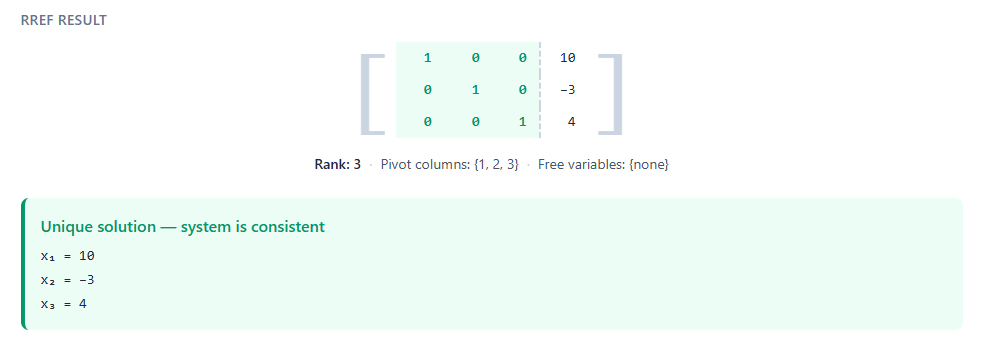
RREF result showing pivot columns, rank, and solution readout from the Matrix RREF Solver.
RREF vs. Row Echelon Form: What Is the Difference?
Row Echelon Form (REF) is usually introduced before RREF. The two forms are related, but RREF imposes stronger conditions.
A matrix is in REF if:
- All nonzero rows are above any zero rows.
- The leading entry of each nonzero row lies strictly to the right of the leading entry in the row above it.
- Every entry below each leading entry is zero.
The leading entries in REF do not have to equal 1.
RREF adds two requirements: every leading entry must be 1, and that leading 1 must be the only nonzero entry in its column.
So Gaussian elimination typically takes a matrix to REF, while Gauss-Jordan elimination continues until the matrix is in RREF.
Consider
[ 2   1   1 ]
[ 4   3   3 ]
[ 8   7   9 ]
Apply R2 = R2 - 2R1 and R3 = R3 - 4R1:
[ 2   1   1 ]
[ 0   1   1 ]
[ 0   3   5 ]
Then R3 = R3 - 3R2:
[ 2   1   1 ]
[ 0   1   1 ]
[ 0   0   2 ]
This is REF. The leading entries form a staircase and everything below them is zero, but the pivot columns have not yet been cleared above the pivots.
Continuing with Gauss-Jordan elimination gives
[ 1   0   0 ]
[ 0   1   0 ]
[ 0   0   1 ]
This is RREF. In this case, the RREF is the identity matrix.
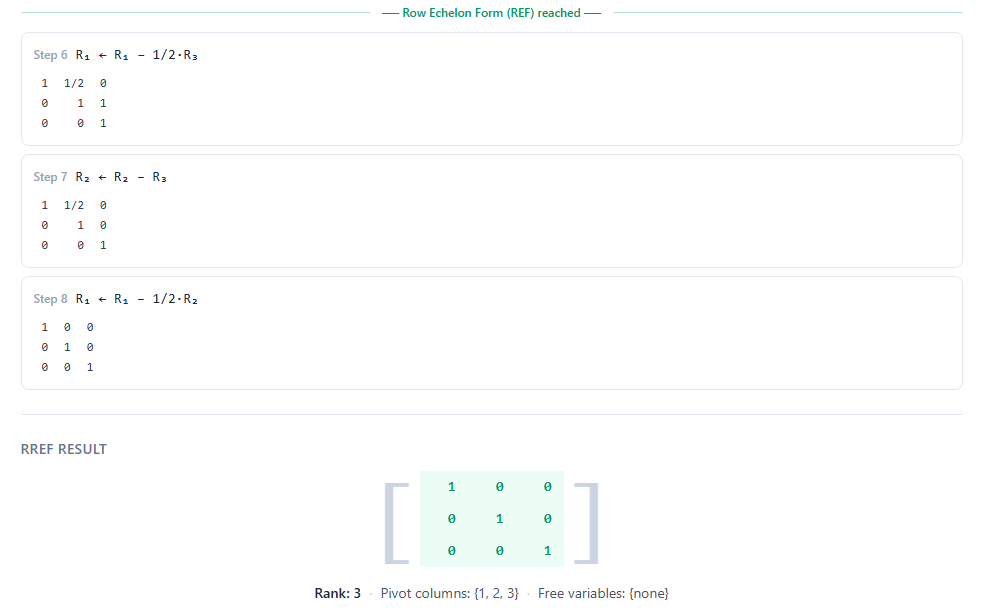
REF reached at the divider line, then back-substitution continues to RREF.
The Four Conditions for RREF
A matrix is in RREF if and only if all four conditions hold:
Condition 1: The first nonzero entry in every nonzero row is 1. This is the row's leading 1.
Condition 2: Each leading 1 is the only nonzero entry in its column.
Condition 3: The leading 1 in each lower row lies strictly to the right of the leading 1 in the row above it.
Condition 4: All zero rows are at the bottom.
A fundamental fact is that the RREF of a matrix is unique. Different valid sequences of row operations may look very different, but they all end at the same reduced row echelon form. This is why RREF is a canonical representative of a matrix's row-equivalence class.
How to Find the RREF of a Matrix
Gauss-Jordan elimination uses three elementary row operations:
- Swap two rows.
- Multiply a row by a nonzero scalar.
- Add a scalar multiple of one row to another row.
These operations generally change the individual equations in a system, but they replace the system by a row-equivalent system with the same solution set.
A practical strategy is:
- Move from left to right, choosing pivot positions and clearing entries below each pivot.
- Scale pivot rows as convenient so that pivots become 1.
- Once echelon form is reached, work upward and clear the entries above each pivot.
If, in the current pivot column, every entry at and below the current row is zero, that column cannot contain the next pivot. Skip it and move right. If it is a coefficient column in an augmented matrix, its variable will be nonbasic (free) provided the system is consistent.
Consider the system:
x + 2y + z = 8
y + 3z = 9
2x + 4y = 8
Its augmented matrix is
[ 1   2   1  |  8 ]
[ 0   1   3  |  9 ]
[ 2   4   0  |  8 ]
First eliminate the entry below the pivot in column 1:
R3 = R3 - 2R1
[ 1   2   1  |  8 ]
[ 0   1   3  |  9 ]
[ 0   0  -2  | -8 ]
Scale row 3:
R3 = (-1/2)R3
[ 1   2   1  |  8 ]
[ 0   1   3  |  9 ]
[ 0   0   1  |  4 ]
Now clear above the pivot in column 3:
R2 = R2 - 3R3
R1 = R1 - R3
[ 1   2   0  |  4 ]
[ 0   1   0  | -3 ]
[ 0   0   1  |  4 ]
Finally clear above the pivot in column 2:
R1 = R1 - 2R2
[ 1   0   0  | 10 ]
[ 0   1   0  | -3 ]
[ 0   0   1  |  4 ]
This is RREF, so:
x = 10, y = -3, z = 4
Substitution verifies all three original equations.
A Messier Example: Row Swaps and Scalar Division
Now consider:
y + z = 5
2x + z = 5
x + y = 3
The augmented matrix is
[ 0   1   1  |  5 ]
[ 2   0   1  |  5 ]
[ 1   1   0  |  3 ]
The first entry is zero, so the standard elimination strategy is to swap in a row with a nonzero entry in column 1. To illustrate both a swap and a scalar division, swap rows 1 and 2:
R1 ↔ R2
[ 2   0   1  |  5 ]
[ 0   1   1  |  5 ]
[ 1   1   0  |  3 ]
Scale row 1:
R1 = (1/2)R1
[ 1   0   1/2  | 5/2 ]
[ 0   1   1    | 5   ]
[ 1   1   0    | 3   ]
Now eliminate below the first two pivots:
R3 = R3 - R1
then:
R3 = R3 - R2
[ 1   0   1/2  |  5/2 ]
[ 0   1   1    |  5   ]
[ 0   0  -3/2  | -9/2 ]
Scale row 3:
R3 = (-2/3)R3
[ 1   0   1/2  | 5/2 ]
[ 0   1   1    | 5   ]
[ 0   0   1    | 3   ]
This completes the forward stage. Clear above the pivot in column 3:
R2 = R2 - R3
R1 = R1 - (1/2)R3
[ 1   0   0  | 1 ]
[ 0   1   0  | 2 ]
[ 0   0   1  | 3 ]
Therefore:
x = 1, y = 2, z = 3
Fractions during elimination are completely normal. They are not evidence that the reduction has gone wrong.
How to Read RREF: Rank, Free Variables, and Solution Types
Once a matrix is in RREF, several structural properties become immediately visible.
Rank
The rank of a matrix is the number of pivot positions in its RREF.
For a system:
Ax = b
two ranks may matter:
- rank(A), the rank of the coefficient matrix;
- rank([A | b]), the rank of the augmented matrix.
These are not automatically the same. In fact, the system is consistent exactly when:
rank(A) = rank([A | b])
A 4 x 4 coefficient matrix of rank 3 has only three linearly independent rows and three linearly independent columns. That does not by itself mean one full equation in Ax = b is redundant; the constants must also satisfy the corresponding dependence.
Free Variables
A variable is free if its coefficient column contains no pivot in the RREF of the system.
For example,
[ 1   2   0  | 4 ]
[ 0   0   1  | 3 ]
represents:
x1 + 2x2 = 4, x3 = 3
Columns 1 and 3 contain pivots, so x1 and x3 are basic variables. Column 2 has no pivot, so x2 is free.
Set:
x2 = t
Then:
x1 = 4 - 2t, x2 = t, x3 = 3
Equivalently:
(x1, x2, x3) = (4, 0, 3) + t(-2, 1, 0)
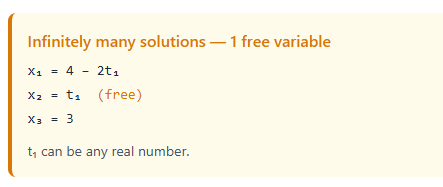
Infinitely many solutions panel showing parametric form from the Matrix RREF Solver.
So the solution set is an affine line in R³.
An underdetermined coefficient matrix with fewer rows than columns must have at least one nonpivot variable column. If the system is consistent, this gives at least one free parameter and therefore infinitely many solutions.
The Three Solution Types
A linear system has exactly one of three outcomes:
One unique solution: The system is consistent and every variable column contains a pivot. There are no free variables.
Infinitely many solutions: The system is consistent and at least one variable column contains no pivot. The solution set is an affine line, plane, or higher-dimensional affine subspace. For a homogeneous system Ax = 0, the solution set is a vector subspace.
No solution: The augmented matrix contains a pivot in the augmented column. In RREF this appears as a row such as
[ 0 0 0 | 5 ]
which represents:
0 = 5
That contradiction makes the system inconsistent.
RREF Calculator
Gauss-Jordan elimination by hand is worth learning because it exposes the structure behind pivots, rank, free variables, and consistency.
Once the method is familiar, however, arithmetic becomes the main source of error.
Our RREF calculator is therefore useful as a verification tool. It reduces the matrix.
You can compare your result with the calculator, and trace any disagreement back to the first incorrect row operation.
For larger matrices, a dedicated software is also the practical choice. The important part is understanding what the returned RREF means and not just merely obtaining it.